Friday, July 24, 2015

A Week in the Life of a PCV: Day Five

Today was essentially a “sick day”.  Nothing to write home about, but I’ve made this silly seven-day commitment!

4:45AM – WHY AM I AWAKE?  Ugh.  Unable to fall back asleep, I put on a movie (which took me the next 5 hours to watch because eventually I started drifting in and out of sleep).

10:00AM – Woke up for real.  It rained all morning, I had no obligations and a gross case of the sniffles, so I decided to stay home in my pajamas and spend a few hours studying for the GRE.

2:00PM – Break time for mac & cheese and “How I Met Your Mother”!  Considered going outside to socialize and get some fresh air, but my nose was runny, my eyes watery, my throat scratchy, my head achey, and I simply had no desire to change out of my pajamas.  Poor Maria.   (Complain complain complain!  Can you imagine how much I’d whine if I fell sick with something real such as malaria?  Ha!)

4:00PM  --  Snuggled up under tons of blankets, chitchatting with friends on the interweb while waiting for Michel to call.  Michel is fish farmer who is just starting to dig his first ponds.  We made plans to meet Friday evening; he said he’d call when he’s ready.

4:30PM  --  Still no word from Michel.  Unfortunately, I had written his number on a scrap of paper, and soon after lost it.  I walked over to his house, only to find that he was not at home.  Instead of our scheduled meeting, I went for a brief walk with Michel’s aunt, accompanying her to the boutique where she had left her cellphone to charge for the day since the power has been out in her side of the village for the past week.  On my way home I stopped to chat with my neighbors, Carol and Michael.

6:00PM  --  I keep seeing articles pop up about this guy who has eaten Chipotle for a gazillion days in a row.  Now, I have learned to adapt and be satisfied with whatever food is available to me.  I no longer request certain goodies in care packages and I am not usually discontented by the lack of variety in my village diet.  However, whenever a friend posts pictures or articles about food on the internet, a flood of cravings washes over me and I become immensely aware of all the happy foods that I am missing out on. (I’ve even started compiling a list: pizza, calzones, raviolis, grilled cheese, quesadillas, pretty much anything with cheese, frozen peas, mint chocolate chip ice cream, all ice cream, sprinkles, milkshakes, brownies, brownie batter, brownies right when they come out of the oven and are still warm and gooey, cookie dough, waffles, bagels, Multigrain Cheerios, Life, all other delicious cereals, Pirates’ Booty, goldfish, granny smith apples, candy, candy, candy, chocolate, etc.)

So anyways, reading about Chipotle Man made my mouth water.

BUT WAIT!  I can have delicious food too, if only I put a little bit of effort into it!  I was so tempted to take the easy route and just have oatmeal for dinner, but I don’t know how many more times I can stand to read about this guy who has been eating Chipotle every single day unless I too, get to eat something extra delicious!

So thank you, Chipotle Man, for inspiring me to make veggie fajitas tonight with homemade tortillas!
Om nom nommm!!!

P.S.  Sniffles are the worst!!! 

P.P.S. In hindsight, I should be grateful for how lucky I am to have the medical care and health status that I do.  Many of my Cameroonian friends fall sick with illnesses much worse than the common cold, and either cannot afford treatment or the hospital cannot properly diagnose them.  A close friend has been stuck in the hospital for a week simply because the doctors have no idea what her illness is.  She will need to be transferred to a more skilled hospital in Yaounde if they cannot figure it out soon.  I'll think twice next time I complain about the sniffles!  (And then I'll probably continue to whine anyways, like the big baby that I am.  But at least I'll be more cognizant!)  --Added July 26th

Thursday, July 23, 2015

A Week in the Life of a PCV: Day Four

Planting rice with Madame Obama.  May 2015.
8:45AM --  After a nice hot shower and some delicious cocoa oats, I began the walk to Dzamtewutug.  Today was greenhouse day!

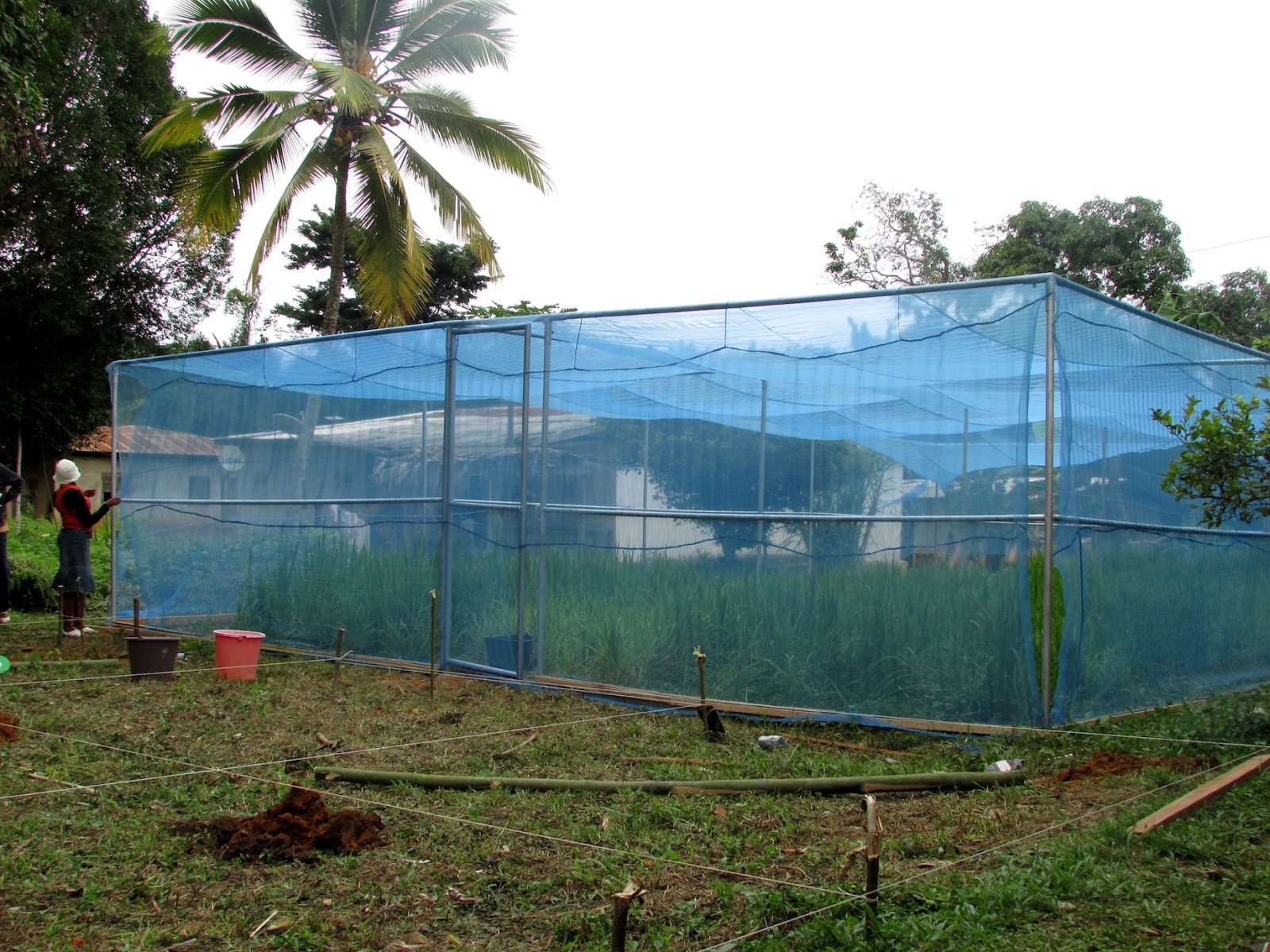
So what’s the deal with these greenhouses that I keep mentioning?  Well, really I should be calling them shade houses.  We’re not aiming for climate control – we’re aiming to keep birds out. (Anti-bird houses?)  In Akono, a family can easily consume several kilograms of rice each week.  However, whenever anyone tries to cultivate their own rice to save on costs, birds will come and eat the entire harvest.  In the past, families would have their children spend entire days by the field to chase away the birds.  Then as soon as the kids went home for dinner, the birds would swoop down and eat all of the rice within minutes!  Scarecrows – or “juju for bird and monkey” as Anglophone Cameroonians like to call them – don’t seem to do the trick either.  Consequently, community members have pretty much given up on cultivating their own rice, and instead they must buy it.

The goal:  to teach 50 local women how to construct these shade houses, have them each construct a shade house of their own, and have them cultivate NERICA rice under the shade house’s protection.

It’s estimated that in a 9m x 15m shade house, a family would be able to harvest up to 300kg of rice per year, thus completely eliminating the need to buy rice.

Today we invited the women to a workshop to learn how to construct one of these shade houses.  The “modern” shade house was already complete upon arrival, save for stitching up some seems in the covering.  However, the technicians wanted to demonstrated how we could construct a more affordable frame using bamboo instead of metal poles.

The construction process took all day (discounting our 2 hour late start, because of "African time"), right up until the women left for 4:00PM mass.

(Somewhere along the way, we had lunch… a hardboiled egg and plantain jam sandwich.  It was really… special.)

Watering the rice.
Stitching up the seems.
Attaching the covering.
A team effort to get the screen cover on the bamboo shade house frame.
"Modern" shade house from the inside.
"Modern" shade house from the outside.
Bamboo shade house from the outside.
EDIT:  I had previously made an error regarding the financing details of this project.   
 

4:00PM  --   Came home to change into pants before taking a moto (motorcycle taxi) to Mfida 4 to visit Mr. Mfugue.  (Mfida 4 is filled with moopmoops – an evil mosquito-like insect that draws blood when it bites and gives you golf ball size lumps that itch for days).

Mr. Mfugue and his wife, Adema,
observing and noting results of a harvest back in May.
Mr. Mfugue is a fish farmer: the first fish farmer that I met in Akono.  He had emptied one of his ponds for a harvest this morning.  Usually I attend harvests, to witness results and to get a bit muddy (the task requires emptying the pond, sinking knee-deep into the mud, and collecting the fish by hand).  Pond harvests are actually my favorite "work" events in my Peace Corps life.  Friends and neighbors come to help out and everyone is jovial, excited to see their success, and knowing that they will eat well and make a bit of money.  Harvest days always end with a jug of palm wine and a feast.  Unfortunately because of the shade house workshop, I was unable to attend this morning's catch.  Nevertheless, I thought I’d swing by to see how it went!

Mr. Mfugue was not thrilled by the outcomes of today’s harvest.  He caught far fewer tilapia than expected (only 700 when he had stocked the 250m2 pond with 500), and both the tilapia and catfish were much smaller than they should have been based on the daily feeding regimen over the past six months.

Nevertheless, he was able to catch plenty of fish to feed his family and guests who are visiting for his daughter's wedding this weekend.

Visiting Mfida 4 is always a pleasant experience.  Mr. Mfugue and his family have become my favorite family to pass an afternoon with.  Mr. Mfugue and his wife Adema are engaged in such a wide variety of agricultural activities that they always have something new to show me.  On top of that, all of their neighbors and family members always welcome me as if I were family (okay, not exactly like family…I never have to do the dishes!).

I spent a few minutes with the ladies in the kitchen-house who were busy making baton de manioc, and then I joined the crowd on the veranda to eat dinner:  fish, cassava, and some palm wine.  Though the conversation was entertaining (subjects included Mr. Mfgugue’s sister’s beard, voodoo dolls, and the high rate of albinism in West Cameroon), eventually I had to pull myself away to make it home before dark.

Mfida ladies making baton de manioc.

6:00PM  --  I waited on the side of the road to flag down a passing car for a ride back to Akono.  Once back in town, I stopped by the bakery to treat myself to a slice of cake (a new addition to the Boulangerie d’Akono!).  Came home, took a shower, planned on saving the cake as a treat for after writing this blog post.  Managed to write one whole sentence before succumbing to my sweet tooth.  Ate the top half of the cake because the bottom half was weirdly soggy.  (My foolishly high expectations were not satisfied.  #1 rule of buying baked goods in Cameroonian boulangeries:  have low-to-zero expectations.  But cake is cake and sugar is sugar so I wasn't totally disappointed!)

And that's a wrap for day four! 


Wednesday, July 22, 2015

A Week in the Life of a PCV: Day Three

Not much going on today, so I'll keep it short and sweet!

9:00AM  --  Wednesday is market day!  Dressed and ready to go, I put on some sunscreen, grabbed my wallet and my market bag, and headed out to buy some groceries.

Akono’s main market day is Wednesday (a couple years ago, they introduced a Saturday petite marché, but it’s not as popular and has less variety).  Whereas evenings were the best time for market shopping in Sanguéré-Paul (anytime before 4PM and vendors would be dozing at their stands!), Akono is a perfect example of “the early bird gets the worm.”  After 10AM, you’ll stand no chance at finding precious items: all the fruit and the best veggies will have already been picked over.

Just as you might imagine, the produce is seasonal.  The types of produce available as well as the price of these goods varies depending on the time of the year.  Currently, we just finished up the season for mangoes and avocados (my favorite season) and are heading into prune and caterpillar season (much less exciting, in my opinion).

The market has a much larger variety of goods besides produce – dried fish, live chickens, secondhand clothing, shoes, jewelry, household supplies, medicines, garden tools, etc.  That said, I rarely buy anything other than fruits and veggies.

Today I spent about an hour wandering around.  I had bought all of my goods in a matter of minutes, but lingered to chitchat with various friends who were also shopping.

4 peppers, 2 onions, 5 tomatoes, 3 carrots, 8 limes, and a bunch of green beans.  Total cost = 1050CFA (just under $2.00).

On my way home, I bought a hearty bean sandwich from Mama Melanie.

11:30AM --  After enjoying my sandwich and copious amounts of tea, I strolled on over to Dzamtewutug to check out the progress of the greenhouse.

The frame had been fully constructed and a local tailor was busy stitching up the screen covering (technically it's a shadehouse, not a greenhouse).  He didn’t seem interested in conversing with me, so I snapped a few pictures and headed home again.


(Tomorrow is a big day for the shadehouse project, so more background information on this project coming soon!)

12:30PM – Mama Sofie, a fish farmer, called to inform me that she had fallen ill and was stuck in Yaounde.  Consequently, she wouldn’t make it to our afternoon pond consultation.  This came as a bit of a relief, as I was beginning to feel a bit under the weather myself.  I decided to just go straight home.

I spent the afternoon hand-washing some laundry, creating a lesson plan for JEMA's waste management project, and studying for the GRE.  As I type this, it’s only 5PM, yet I feel overcome by sleepiness.  Plan for the rest of the night?  I’ll make some tomato soup, put on a movie, and hope that I can stay awake until a reasonable bedtime hour.  (Why isn’t it dark out yet?!)

Tuesday, July 21, 2015

A Week in the Life of a PCV: Day Two.

My morning commute.

9:30AM  --  Up and at ‘em!  I lounged around in bed until the rain subsided (plus a half an hour to give the unpaved jungle roads some time to dry), and then was on my way!  I rode my bike 12km to the cassava farm in Mfida 3, a village outside of Akono.

Tithonia Diversifolia
Whenever I have a Tuesday or Thursday free, I head over to Mfida 3, where I join a group of women on their cassava farm.  While each woman has her own personal farm, this shared plot is an experimental farm.  They’ve divided up the land into sections to test which technique produces the highest yield:  traditional planting methods, “improved” planting methods, with Tithonia diversifolia (a weed that can be used as a natural fertilizer and insecticide that wards off root-eating pests), and without Tithonia diversifolia.  So in the morning, I ride my bike through the jungle til I reach the farm, and then we work until it becomes too hot.  On my first day visiting the farm, the women were a bit skeptical of me: “who is this white girl coming to disturb our productive workday?”  But once I proved I was willing to get dirty and work hard, they warmed right up to me.  They were impressed with my hoe-wielding skills, while I was impressed by how these mamas do this every single day without their hamstrings burning as bad as mine.  These women are amazingly strong and hardworking, and more importantly, they are kind.  Ever since that first day, they welcome me with smiles and hugs, and send me away with a backpack full of mangoes.  I've learned to look forward to their company on Tuesdays and Thursdays, as much as I look forward to the wonderful workout that comes with tilling the Earth.

Mama Alphonsine counting out Tithonia diversifolia leaves.  May 2015.
Mama Helene preparing to plant cassava.  May 2015.

Ntie
Anyways, I was psyched for a long day of farming, but I arrived at the pond only to find that the ladies decided not to work this Tuesday!  Nevertheless, the ride was not a total waste; my friend Ntie flagged me down as I was riding past.  Together we walked around the farm to observe which parcels were producing well and which were not.  It was hugely evident that the improved methods and Tithonia diversifolia yielded better results.  Ntie explained to me that they had obtained their objectives with this project: the women were sufficiently convinced that these new methods were the way to go.  Because they were able to see the results for themselves, they were convinced and ready to begin applying these same techniques on their own farms.  Success!!

The field today.
I had intended to continue my bike ride to visit Mr. Mfugue, a fish farmer in Mfida 4, but Ntie informed me that Mrs. Mfugue was sick and they had gone to town for medicine. 

12:00PM --  I arrived back to Akono and was suddenly super hungry, so I stopped by Mama Melanie’s food stand for a bean sandwich before going home.  Melanie is my favorite food vendor in town.  During my first weeks in Akono, she won me over as a customer by literally dragging me away from other food vendors and giving me free beignets.  Some days I’ll hang out and help her make sandwiches (at first, clients are annoyed at how long I take to crack hard-boiled eggs or de-bone fish, but they always walk away pleased when they see how generous I am with sauces!).  Today was I was sweaty from my bikeride and didn't want to linger, so after exchanging some village gossip, I took my sandwich to go.

Before getting back on my bike, I ran into Raphael, a fish farmer and the head of the cassava farm that I had just visited in Mfida 3.  We had a nice chat about work before each of us were on our way.

12:30PM --  Not even home for ten minutes before it starts raining!  It continued to rain for the next two hours.  Since farming and visiting Mr. Mfugue were the only things on my agenda for the day, and since they both fell through, I was now free to hang out.  Nobody ventures outside in Cameroon when it rains, so I took advantage of this time and had a guilt-free afternoon of reading and napping.

3:30PM --  I went for a walk to visit some friends, but none of these friends were in their usual stomping grounds:  Carole wasn’t home, Rashida wasn't in her tailor shop, Frida wasn’t at the mechanic’s shop, Patience wasn’t at her bar.  So instead I bought a kilo of peanuts to roast and supplies to make brownies later in the week.

4:15PM --  Roasted some peanuts, ate some peanuts.  Made vocab flashcards for the GRE.

5:30PM --  My legs were tired from my bike ride, but it was such a beautiful day that I decided to go for another evening run.  I returned home just in time for a quick phone call with my Mama!

Overall it was a laid back day.  My main plans fell through, which happens pretty often.  I’ve learned to appreciate days when I can lounge around and read.  Okay…sometimes these types of days drive me crazy.  Sometimes I get frustrated at the slow paced life, wishing for more structure, more work, more "to-dos".  Today though, today it was nice.

Three things that made me smile today: 
  1. My morning bike ride through the jungle was amazing as always, and reminded me how lucky I am to be here.
  2. I had a really nice chitchat with a long lost friend (talkin' bout you, Markalark!)
  3. Sour gummy worms!

Monday, July 20, 2015

A week in the life of a PCV: Day One

Sorry for slacking off once again... I was off galavanting in Turkey and Israel, getting up to amazing adventures with amazing people!  Back in the 'roon now, and ready for my last three months of service!  

******************************************************************************************************
Many friends from home have asked me in the past couple weeks:  What exactly do you do everyday? 

It’s a question that I always have a difficult time answering, because I have no fixed schedule.  Some days are jam-packed with activities and meetings (some planned, some spontaneous); other days I have an inordinate amount of free time that either A) forces me to get creative in how I spend it, or B) drives me mildly insane.  

I realize that this does not exactly answer the question:  What exactly do I do everyday?   I usually try to avoid play-by-plays in my blog, sharing only major events and avoiding the mundane, but I guess what has become mundane for me might still be interesting for others... Maybe?  We'll see!  

So here we go!  Seven blog posts for seven days:  a week in the life of, err.. me!

MONDAY
5:30AM  --  I woke up too early this morning.  It was still pitch black outside, and thus an ungodly hour at which no human being should ever be awake.  Yet I had foolishly turned my lights out at 7:30PM last night, falling asleep before 9, so it was my own darn fault.  I debated getting out of bed, but like I said – it was far too earlyI have a mental block against getting out of bed before 8:00, unless it’s to make breakfast to bring back to bed, which is exactly what I did this morning.  Cocoa oats, as I like to call it:  oatmeal with hot chocolate powder.  I like to pretend it’s the healthy version of Cocoa Puffs.

Snuggling back under all of my blankets (it was a brisk 70º), I enjoyed my cocoa oats while reading a book.  About an hour later, it was time for a nap.  Oh wait, you weren't expecting details of my breakfast and naps??  Oh... Okay.

8:35AM --  I woke up to my alarm at the absolute latest time that I could roll out of bed, get dressed, and make it to my 9AM meeting.  

9:00AM  --  I was searching for the path that leads to Mr. Ndzana’s ponds.  I’ve only been there once before, and the bushes have grown quite a bit since then.  Eventually I heard a radio playing and the sound of a machete hacking away at weeds, and guessed that this was probably the right path.  Voila!  Mr. Ndzana!

We spent the next hour walking around his three ponds, discussing the work that he’s accomplished in the past month and what he can do next.  Mr. Ndzana is a primary school teacher and constructed these ponds as a side activity, but is enthusiastic and eager to learn the ins-and-outs of aquaculture.  We scheduled a time to meet in my office next week so that we can sit down and discuss further.

As we left the ponds, we waked through his small garden and picked some ripe guava fruits to eat as we walked back to town.  Mr. Nzana and I parted ways at the Akono Educational Block (where all of the schools are located), where I ran into the director of the primary school.  We briefly discussed the details of our library project, which will hopefully be complete by September/October.

11:15AM  --  I had been home and frantically researching grad programs and potential jobs (ugh!) for about 20 minutes when I heard Madame Obama calling my name from outside.  Apparently we were supposed to be meeting the trainers and technicians of FECDEC’s greenhouse project at Dzamtewutug (pronounced jam-too-woo-too, duhhh!).

We walked the 25 minutes to the agricultural school at Dzamtewutug and spent the next two hours sitting and watching technicians dig holes.  The women of FECDEC were frustrated that I didn’t bring my camera; I was frustrated that they only invited me to use my camera.  With no tasks at hand, I tried to make small-talk with Madame Obama and Mama Marie-Therese, but they kept dozing off, so I spent the better part of two hours daydreaming -- something that I've become really good at in Cameroon.

I was relieved when it was finally time to go home.  Being useless was getting a bit dull.  (At least at home, I can be useless on my own terms!)  I made mac & cheese using the 1lb jar of delightfully bright orange cheese powder that my Mama sent me in a care package, and spent the afternoon reading.

4:00PM  --   Yves, the president of JEMA, came over to discuss a few project plans.  We discussed JEMA’s upcoming waste management project, as well as the upcoming cultural summer camp that we’re going to infiltrate with lessons about various health and environmental topics.  Yves is a wonderful counterpart; he's always coming up with new ideas and is incredibly receptive to suggestions.  We both walked away from this meeting feeling positive about these upcoming projects.

5:30PM  --   When Yves left, I slapped on my sneakers and went for an hour long run, to my favorite tree and back.  It had rained earlier in the afternoon, the air was fresh and the sky was still filled with clouds -- a perfect evening for a run! 

Three things that made me smile today:
  1. I saw a baby goat.  It was incredibly cute and fluffy and just the best thing ever. 
  2. I’m really excited about launching the waste management project with JEMA.  It feels great to have one last big project to focus on before finishing my service.
  3. “Rockin’ Robin” came on shuffle while I was running, and reminded me of Montreal runs with my roommate Claire, when we would accidentally get a few miles off-course but power through by singing oldies at the top of our lungs and looking like nitwits.  

Monday, May 25, 2015

Parlez-vous français?

The other day I was greeted by a man in a language non-native to Akono.  Having never heard the language before and thus not understanding a single word, I returned his greeting with a simple wave. The conversation that followed went a bit like this:
(Anything in italics is translated from French.)
Man:  Why wont you greet me in my patois?  You’re living in our country, you should learn our patois.

Maria: Sorry, but did you think I could learn all 262 languages?

Man:  You could at least try.

Maria:  Okay, I’ll try.  But since Cameroon is ‘bilingual’, how about you try greeting me in English.

Man: *uncomfortably long pause*  Good day

Maria:  Good day, how are you?

Man: *even longer pause*  Thank you.

Maria:  Guess that's it for English...

Man:  Gutentag!

Maria:  Buenos dias!  Como estas?

Man: If you were Chinese, I would tell you ‘heehaw’!
Maria:  No, because that is the sound that an animal makes, and many foreigners dislike that very much.  It’s ‘nihao’.

Entire bar: Nihao!

Man:  Nihao!

Maria: Djam bandu na?  (Bringing out a bit of my rusty fulfulde here!)

Man:  Djam koo dume.

One of Cameroon’s many special qualities is its huge array of languages.  While the two official languages are French and English (with 8 francophone regions and 2 anglophone regions), there are more than 200 local languages (230 according to Wikipedia, 262 according to my counterpart's husband).

As a recent article in The Washington Post stated, “if you randomly select two people in Cameroon, for instance, there is a 97 percent likelihood that they will have different mother tongues. In the United States, there is only a 33 percent likelihood that this is going to happen.”  Furthermore, I’d be willing to bet that if you picked any Cameroonian at random, there’s a strong chance that he/she can get by in at least one other patois beside his/her own.  For example, most people in Akono who have moved here from other regions have learned to communicate in Ewondo.  Oftentimes, people will also learn the patois of their spouse if marrying someone from a different village.  My friend Olivier from Sanguéré-Paul speaks his own language (Mundung), Fulfulde, French, English (at least as much as he learned in school) and could hold basic conversations in at least three local patois other than his own.

Peace Corps Volunteers are granted the unique opportunity to dive into the cultures of little pockets of the world -- cultures that they might never have heard of otherwise.  Before coming to Cameroon, had I heard of Akono?  Did I know that Ewondo was a language?  Nope, absolutely not.  I was focused on just learning French!  Now not only can I speak french (albeit Cameroonian French: “Tu es la? Oui, je suis la.  C’est comment?  Ouaaaaai!”), I can toss a bit of Ewondo and Fulfulde into the mix.  Without Peace Corps, my French would be still be limited to ordering off of menus in Montreal or listening to Quebecois radio with my Mom, translating every other word.  Now, I'm thrown off when anyone in Akono speaks to me in English -- I will automatically respond in French.  Without having lived Northern Cameroon, I would have no idea how to surprise the Fulbe smoothie guy in Yaounde by saying "useko sobajo!" as I walk away. 

PC Cameroon is not unique in offering experiences with new languages.  My favorite language moment occurred while Leana and I were in Zambia.  The official language of Zambia is English.  However in the remote villages, where many of the PCVs work and live, many people lack formal education and the patois are still primarily spoken.  Our host, Mike Preisler, brought us to dig a pond with an agricultural cooperative.  The patois in Mike’s village, and thus the language that he uses everyday to communicate, is Kaonde.  This cooperative, however, consisted of many men and women who had moved from the Congo.  They were more familiar with one of Zambia’s other patois: Lunda, a language that Mike had a decent grasp of as well, and the language that another PCV who joined us, Emily, was fluent in.


Here’s where the fun began:  Having lived in the Congo, a few of these farmers could speak French and Swahili (I only remember a small amount of Swahili, but having spent a couple years in Tanzania, Leana could hold her own in a conversation).  So as we were digging, we were all chitchatting back and forth in five different languages:  Kaonde, Lunda, English, French, and Swahili.  Mike would speak with the farmers in Kaonde or Lunda, Emily in Lunda, Leana in Swahili, and myself in French.  It was amazing to see us all communicating effectively even though most of us (PCVs and farmers alike) were speaking second languages the whole time.  And let me tell you, if I’m going to be shoveling dirt all day, I need a good distraction like that!  It got the whole crowd laughing and having a good time, which I have a feeling is a rare occurrence while shoveling dirt under the hot, Sub-Saharan sun.
After we had finished up for the day, Moses, the host of the site, invited us for lunch.  Upon receiving the food, we each went around and said ‘thank you’ in a different language.

To any prospective PCVs reading this: even if you walk away from your Peace Corps service with nothing else (though trust me, you’ll walk away with A LOT), chances are you will walk away having learned a new language.

On that note (sorry if you've seen this already via facebook or err...my mom):  A few months ago, I put together a quick video to demonstrate the wide variety of languages that can be found in Cameroon.  While the main patois in Akono is Ewondo, so many more can be found even in this small village.  (And this video really only scratches the surface).  You can check it below!


Monday, May 11, 2015

Mobile Youth of Akono

A major theme that came up often during my field studies program in East Africa was rural-to-urban migration – a phenomenon in many, if not all, developing countries in which many people will move from their villages to seek economic gain (among other advantages) in the up-and-coming cities.  While it’s true that this allows for family members to make a bit of money to send home (sometimes), it also robs the rural villages of a young workforce.

Akono is definitely affected but this rural-to-urban migration phenomenon.  The other day while I was in a nearby village farming cassava with a women’s cooperative, we were laughing about how out of the twenty women present, only two (myself included) were under the age of fifty.  The women admitted that all of their children who were my age had moved to Yaoundé or another city.

In Akono it is evident that there is a lack of young adults.  Equipped with four primary schools and three high schools, the village attracts many children from surrounding villages, who either spend the school year at relatives’ homes or rent a bedroom in one of Akono’s many lodges.  When school year is over, they return to their own villages.  Once they graduate high school (or if for some reason they drop out of school – a far too frequent occurrence), they often leave for the big city where they hope to find work.  The young men that stay in town typically opt for a job driving motorcycle taxis.  So, aside from the children, the moto-taximen, and the people who were affected here to work government jobs or to work for the church, the majority of the population consists of older people.

I’ve heard from many different people (e.g., the cassava cooperative, some of my fish farmers, even friends from my old village in the North) who say that the youths seek easy money.  Driving moto-taxis is a good way to make a quick buck (and if Cameroon had more of a saving culture, these drivers would be doing quite well for themselves).  The women at the cassava cooperative claim that the Cameroon's modern youth have little-to-zero interest in learning or practicing agriculture because it is work that takes much time and effort.  (And thus they found it quite amusing to see a young white lady wielding a hoe under the hot African sun.)

Anyways, that was not exactly what I came here to tell you about, but it’s a good introduction.  What I came here to tell you about today is this amazingly dynamic group of youths in Akono who started a volunteer organization to work towards development: Jeunesse Mobile d’Akono (Mobile Youth of Akono, or JEMA).

JEMA, an association consisting of mostly men (I’m pushing to recruit more women) between the ages of 20 and 30, focuses on developing Akono through education, health, and environment.  While I've been hearing that young people from Akono typically move to Yaoundé, it's exciting to have found a special group who have not only chosen to stay, but have chosen to stay and help their community.

I was first introduced to JEMA a few months ago, but recently we’ve begun working more hand-in-hand.  It started last week when I taught lessons about malaria to two of the primary schools.  A few days after my lessons, I met with JEMA and they told me that one of the main things they wanted to do for Akono was to help reduce the high rates of malaria.  So a few days later, we visited another primary school so that they could first watch my lesson, and then teach alongside me to other groups of students.  So far we’ve reached 585 students and plan to reach out to the high schools in the coming weeks.

In their study of local needs, that they found was that the hospital was not fully equipped for proper sanitation.  I can’t really give you a reason for why a government hospital happened to not have enough gloves, soap, bleach, brooms, etc., but that’s just how it was.  So members of JEMA got together and each contributed 3,000CFA ($6), and today we went to present our donation to the hospital: 2 buckets, 2 pairs of gloves, 2 bottles of bleach, 2 bags of detergent, 2 brooms, and 2 squeegees.  It’s not much, but it’s better than nothing.  And what’s even better than "better than nothing" is that this group of young people saw a problem and cared enough to make a change.

I am incredibly excited to begin working towards development with this dynamic group of young people.  But do you know what’s even cooler than our shared interest in development?  They are interested in learning as much as they possibly can.  So, people are late for our meeting?  No problem!  Let me just whip out this book about the discourses of famous politicians.  Or, let’s ask Maria about where she came from, or about how the other places she’s visited in Africa compare to Cameroon.  Or, let’s discuss the global economy!  Or even, hey Maria!  You know aquaculture… why is that pond a different color than that other pond?

Never a dull moment with JEMA!  I’m proud to be associated with this association.  I look forward to the work that we will accomplish together, as much as I look forward to expanding my French vocabulary with all of our intellectual conversations.

Members of JEMA, myself, and the head doctor at the Akono Centre de Santé.