Saturday, January 18, 2014

A Day in Adoumri: Always wear your red shirt when visiting the slaughterhouse

One of the benefits with working for such a large, widespread organization is having the opportunity to see other parts of the country by visiting other volunteers.  Last Thursday, I adventured to Adoumri to visit Joe, another Agroforestry volunteer from my stage.

Adoumri is about two hours away from Sanguéré-Paul.  I managed to drag myself out of the house by 8AM, took the bus to Garoua, and then took a taxi to Pitoa with five other passengers.  Joe’s counterpart, Huseni, had arranged for a friend to meet me in Pitoa and give me a ride to Adoumri.  At first I was a bit concerned about how I would possibly know which strange man I was supposed to be traveling with, but I figured when I got out of the taxi at the carrefour, it was a safe bet to go with the only person who called “Maria” rather than “la blanche” or “Nassara”.  Hooray for having a real identity!  I hopped on the back of his motorcycle, and we set off for the bumpy 50 minute ride down the unpaved road to Adoumri. 

We arrived at Huseni’s house at about 10AM, was greeted warmly by his family, and Joe arrived a few minutes afterwards.  After chatting for a bit, they decided to show me the town.  Adoumri is a lot bigger than Sanguéré-Paul, with a population of over 16,000 people.  Now that I think about it, that’s still smaller than my hometown back in Massachusetts, but compared to Sanguéré-Paul’s population of 3500?  Wheeeewph!  When I asked Joe whether he lives close to the market, he replied “it’s about a 15 minute walk, so yeah, I’d say that’s pretty close.”  Chez moi in good ol’ S.P., the market is only two minutes away, as is pretty much everywhere else I would possibly ever need to go! 

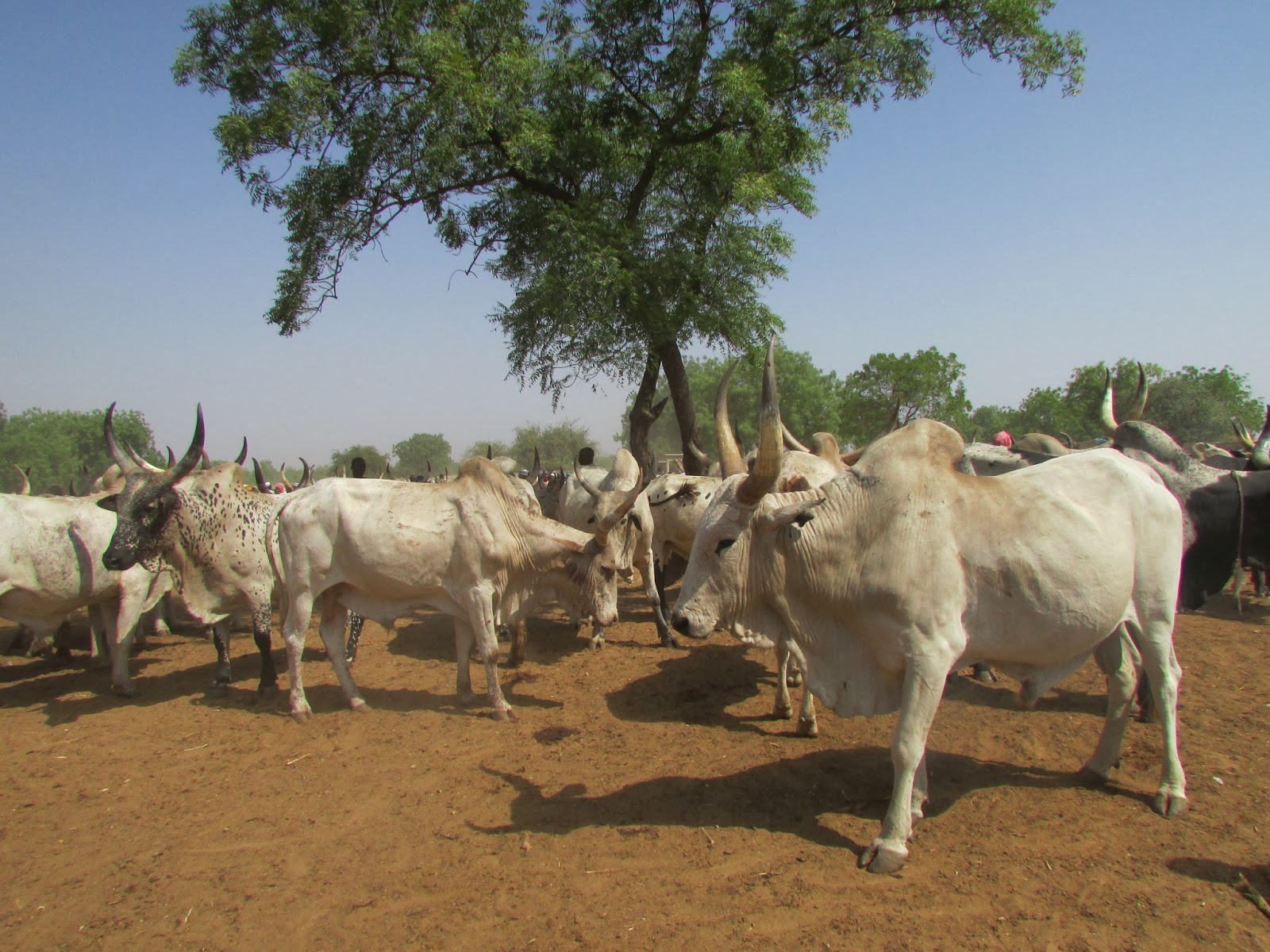
Anyways, Thursday is Adoumri’s market day, and if there’s one thing that this village is known for, it’s the cattle market.  Every Thursday, cows come from all over to do their shopping.  I mean…what?  No.  Every Thursday, cows are brought from all over – not just Cameroon, but also Chad, Nigeria, and Central African Republic.  The herdsmen and their cows (and sheep and goats too) walk hundreds or thousands of miles simply because this is the best cattle market around.  Customers will come to either buy a herd of cows, or an individual cow, with prices ranging from 100,000CFA ($200) to 500,000CFA ($1000) each.

There must have been thousands of them, and as we were weaving in and out of the crowd, I was hesitant to take pictures for fear of accidentally bumping into a giant bull and consequently receiving a 3-foot horn through my head.  The pictures that I did manage to take simply could not capture the immensity of the market (nor the immensity of some of these cows). 

Cow butts.
The pen where all the unsold cows will sleep after the market, with their herdsmen sleeping outside around them, resting up for the next leg of their journey.
I saw every single part of a cow that I had never hoped to see – from the icky male parts (this thing is beyond proper terminology.  I think I am scarred for life) protruding from a bull as he tried to sexually assault a poor non-consenting lady cow in broad daylight (his herdsman promptly whipped him and told him to cut it out), to the buckets-full of undigested grass that was pulled from a cows stomach after he met his death. 

That brings me to our next activity:  the slaughterhouse.  Let me tell you, folks:  slaughterhouses are not for the weak-stomached, or for vegetarians, or probably anyone who still likes Disney movies (not that I can think of any Disney movies that have cows in them, but I assume that if you still appreciate animals that can sing and dance, you probably are not in the same category of people that gets a kick out of watching a creature get sliced open and chopped to pieces as puddles of fresh, bright-red blood forms around it). 

What was I saying?  Oh yes, the slaughterhouse.  As we crossed over the dried-up river to the “abbatoir”, I saw a humungous white bull (a 500,000CFA-er) being led by a rope, and putting up a good fight.  The poor guy knew what was coming to him… he could probably smell it in the air, and he was doing everything in his power to prevent the inevitable.  No such luck. 

I’ll avoid the gruesome details, and the gorey pictures that Huseni insisted on taking with my camera (if you are really interested, or perhaps if “Bambi” is no longer satisfying your entertainment needs, let me know and I’ll email them to you). 

Don’t get me wrong – this is definitely no PETA-ish tirade.  Despite my squeamishness at the slaughterhouse, I was not at all opposed to what was happening in front of me.  In fact, I was pretty darn impressed.  These guys, equipped in their brightest red shirts for stain control, knew how to handle a bull.  Within seconds of entering the slaughterhouse, he was down on the ground.  Within minutes, he was killed and being disassembled.  Within the hour, the next bull was being brought in. 

Not only were they efficient in their work, they were conscientious to save each and every part.  As the cow took his final breaths, young boys were rotating shifts catching the blood that spewed from his neck.  This blood would later be cooked an eaten (apparently it tastes like liver…mmm!)  As they pulled various organs out, I kept asking the woman next to me, “what’s that?  What’s that?” to which the response was more frequently than not “that part’s delicious!”  Even the brain is eaten.  The parts that cannot be eaten by humans will be cooked and fed to dogs.  The heaps and heaps of undigested grass, which I mentioned earlier, are used for compost.  The leather is saved to use for whatever leathery purpose, and the horns are kept by children or turned into artisan crafts to be sold in tourist markets.  Talk about maximizing resources!  

The cow's stomach before it was carted away to be emptied of the grass inside.
Omnomnom.
After Huseni insisted that we wander into the slaughterhouse and weave in and out of the meat, it was decided that we had all had enough.  After resting up and avoiding the heat at Joes house, it was eventually time for me to go home.  Huseni’s friend drove me back to Pitoa, I hardly had time to thank him for the ride before being thrown into a taxi to Garoua, and I was back at my house before sunset.

All in all, it was a good visit.  Despite how it may sound, I was actually really glad to have an opportunity to see the slaughterhouse and to see the massive livestock market – an opportunity to learn a little bit more about the lifestyle here in Northern Cameroon.  It also made me truly appreciate my own little village, where people buy their meat elsewhere.

Thursday, January 9, 2014

What the heck am I doing?!

The question that I’ve been asked most frequently by the folks back home is: "What kind of work are you doing over there in Africa?” 


Officially I am here in Cameroon as an agroforestry volunteer, working as part of a program called “Sustainable Livelihoods.”  (Previously being the environment sector, with the program L.I.F.E: Linking Income, Food, and Environment, but things are always a-changin’!)  The main objectives of this program are as follows:
  1. Strengthen the production and value addition of agricultural goods
  2. Promote sustainable agri-business initiatives. 

So what am I actually doing?  Ha. *Ahem*.  Errm... Well, that’s a very good question, and to be honest, every time I am asked this question, I am a little bit stumped and a little bit disheartened, because I really just don’t know yet.

I cannot tell a lie:  I have had a few days where I barely left the house at all, and instead stayed inside watching sitcoms or reading all day, being a “complete waste of space”, as my friend Lianna would say.  I’ve had days where the best I could manage was to fetch water, or to drag myself to the carrefour to buy peanuts just to force some human interaction. (Keep in mind that I had this same problem in Montreal, where I had to create goals for myself:  Today I will speak with at least 5 people, and according to my mom, the mailman and the cashier at the grocery store didn’t count.  So you can only imagine how difficult it is for me to go out and face the world in a foreign language!).  I’ve had days where I’ve been frustrated beyond belief for feeling so completely idol in a foreign country, and for not being able to do anything tangibly productive.

Then I remember that this is normal. (Kind of.  Well, parts of it, anyway).  It is not expected, and not even encouraged, to just start up a bunch of projects upon arrival to post.  The first few months are primarily for getting settled into a new home, a new community, and a new culture.  These first few months, I am here not to create change, but rather to observe, to learn, to adapt.  Each day, I coax myself out of the house to go for little walks, sit with neighbors, and practice Fulfulde with people at the carrefour. I am doing my best to build friendships, build trust, and to build a life for myself here.  Along with this, I am taking French classes and Fulfulde classes, because as always, communication is key.

I am taking time to learn about Sanguéré-Paul.  After all, how can you start a bunch of development projects without knowing what the community’s needs are?  So far, I have only conducted informal interviews with friends that I have made and community members who are patient enough to try to endure my accent.  Through these conversations, I have learned what the community members believe to be the most pressing problems in the village.

The other day, my friend Gargasol invited me over to meet his family and to discuss development.  He asked me how Sanguéré-Paul can become developed.  At first, I kind of thought this was a rhetorical question, or that he was going to give me his own opinions, so I sat quietly waiting for him to continue speaking.  Nope.  He was truly asking me, because after all, this is what I went to university for;  I should have all the answers, right?  When I realized that he was, in fact, expecting an response, the best I could say was that there was not one simple solution.  If it were that easy, well, then it wouldn’t be so darn difficult!  If there were one quick fix to development, then we probably wouldn’t still be having this conversation, and organizations like the Peace Corps wouldn’t be working in the same country for 50+ years.  Sanguéré-Paul will have to work towards development by attacking their challenges from all angles.  We need to consider all of the challenges that people face everyday, and then work our hardest to find ways to overcome those challenges in a sustainable fashion.

We discussed striving for general improvements in education, health, environment, and economic situation, and we discussed how many different factors have to work together in order for the village’s development to progress.  Then I asked him what he thought were the most pressing needs of Sanguéré-Paul:

  • Water.  There is not enough potable water here.  They want to build more wells, and need to build more wells, but this is expensive and they need to collect money from each household.  He recounted the situation of Sanguéré-Ngaoundéré, which is at the junction of N1 and the road to Djalingo, about 3km from Sanguéré-Paul.  In Sanguéré-Ngaoundéré, there is hardly any water at all.  People are drinking water from streams, or wherever they can find it.  Consequently, the health conditions are terrible and there is an extremely high prevalence of typhoid and dysentery, as well as other diseases.
  • Health.  There is a health center here in Sanguéré-Paul, but it’s not open yet and there is no equipment.  The building was constructed a few years ago, with funding from the US Embassy, and now it’s up to the municipality to hold their end of the deal by financing the equipment and hiring the staff.  Nobody knows whether the municipality is still working on this or if they have just forgotten/given up.  “How are we supposed to treat our children’s illnesses if there is no health center?”  The closest health center is in Djalingo, which is 5km and a 400cfa moto-ride away.  Many people have difficulty finding money to buy medicine for their children.  Gargasol’s son currently has malaria, but he has no way of treating it.
  • Trees.  People are cutting trees en brousse and not planting more.  I’ve heard many people state this as a problem.  Gargasol would like to start a nursery and plant trees in his yard (specifically a mango tree so that he can generate income by selling mangoes).
  • Education, just in general.  Keeping kids in school is key.  School fees are expensive (7,500cfa per year at the primary school, and 23,000cfa per year at the high school), and if you don’t have the means to pay, you aren’t allowed to go to school.
  • Food sources.  Like many other people in the village, Gargasol doesn’t have a formal job.  He used to work for IRAD, and he still tries to find little bits income here and there, but there is no work to be found anywhere.  The family has great difficulty finding enough food or money to buy food.  On top of it all, he has to take care of many of his brothers, including one brother who is in prison, who he delivers food to occasionally.
  • Drugs. There are many young men (17-18 years old) who are taking drugs (I’m not exactly sure what kind of drug).  This wasn’t a problem before the year 2000, but between then and now, it has become a problem.  Many people are scared of the carrefour because of these aggressive boys.  I explained that I, too, am scared of these boys, and it is probably not safe for me to go directly interact with them, and also there is probably not an easy way to get them to stop taking drugs.  Instead we discussed that a sensitization course at the school would be best.  A method of prevention.  We need to teach kids in school about the negative effects of drugs, keep kids in school, and create more afterschool activities so that kids are not idol.
  • We also just talked generally about how it is important to think of the children’s future, and ensuring that they will survive and have good lives after the current generation is no longer around.
This conversation, which lasted almost two hours, left me feeling challenged and a bit overwhelmed, but extremely motivated.  That being said, not many of these problems are agroforestry related (though the agri-business and economic aspects will certainly prove beneficial).  Personally, I have no problem with this.  I am willing and eager to help in any domain that I can.  However, Peace Corps requires that I at least try to do work within my sector, and I’m sure as I talk to more people in the community, I will find plenty of ways to do so.

So what exactly am I doing here in Sanguéré-Paul?  I’m learning.  I’m learning how to coax myself out of my shell and that sometimes all it takes to start a conversation is a simple greeting.  I'm learning a new language and a new culture.  I'm learning how to fit in in a place where there is absolutely no one who looks like me or shares a common background with me.  I’m learning about my new community and the challenges it faces.  I’m learning about development in ways that a classroom could never teach me.  And with all that I am learning, I will hopefully soon be able to work together with the people of Sanguéré-Paul on a path towards a better future.

Monday, January 6, 2014

You've got questions? I've got answers!

It's been about a month and a half here in Sanguéré-Paul, and I seem to be getting a lot of recurring questions from friends and family, so I figured why not put 'em all together and answer everyone at once?  I'm always willing to answer questions, so never hesitate to ask!

Q:  How hot is it?
A:  HAWT.  My default answer to this has been 104°F, but this was based off the only time I had ever seen a thermometer, which was over a month ago on Thanksgiving.  Well, I now have a brand spankin’ new thermometer, so I can answer this question for real!  (Let’s keep in mind that it is currently “cold season”).  I woke up this morning and thermometer was hovering around 70° up until 8 or 9AM.  It’s always a bit cooler in my house, but my thermometer is placed in the shade on my veranda.  Throughout the day, the needle usually hovers around 90°.  By now, this is what feels comfortable – much more comfortable than the morning briskness that makes me thankful that I brought a sweatshirt and winter leggings (because yes, 70° really does feel that cold to me now!).  So just to do a little experiment, I put the thermometer out in the sun.  After all, if I go for a walk there’s not always an easy way to find refuge in the shade!  And guess what the thermometer said?  (Well, nothing, of course! Because it can’t talk!  harharhar)  We’re back to my default answer: 104°.
EDIT (1/22/2014):  This happened:
And apparently this is nothing compared to what's coming in March.
EDIT (3/31/2014):  It's officially hot season.  130° (at least!) in the sun, 105° in the shade. Sweat.  So much sweat.

Q:  What do people in Sanguéré-Paul do for fun?
A:  I'm becoming a bit better able to answer this question each and every day.  There is an outdoor “cabaret” that runs probably from noon to midnight everyday (and even later during the holiday season), and music is blaring while everybody drinks bil-bil (local bear) and dances.  Then again, those who don't drink usually avoid the cabaret.  I often here a lot of drumming and singing happening at the church near my house, though this is most likely associated with the holidays or other celebrations.  During the holidays, various church groups put on theater performances, which drew quite a crowd and caused a lot of laughs (though it was all in Fulfulde, so the jokes were all lost on me).  Children can be found singing and chasing each other around – the other day, I’m pretty sure I witnessed a Fulfulde version of “ring-around-the-rosie”.  Kids are always playing everyday objects that they have turned into toys, the most common being old bike tires, which they will tap with a stick and chase it down the path.  Then of course, soccer is extremely popular all throughout Cameroon – both watching it and playing it.  I have also seen many people playing cards, though I have not yet had the courage to join.  


Q: How is the Fulfulde coming along?
A: Seda seda.  Petit à petit.  Ça va aller.  I’ve got my salutations down, or so I think.  I can usually hold a conversation of 5 or 6 questions back and forth until I give a blank stare and get laughed at (in the nicest way possible, or so I like to pretend).  These questions include:  How’s it going?  How is your health?  How is the house?  Did you sleep well?  How is the fatigue? How is the cold?  (YES!  THEY REALLY ASK THIS!)  And sometimes, noy gorko ma?  (How is your man?)  -- A question to which I awkwardly laugh because I don’t know how to explain that no, I do not have a husband and I am not currently looking for one (though when speaking French I sometimes pretend that I’m married to my cat.  This confuses people.  I don’t think they get me...) 

Q: So…what kind of actual work are you doing right now?
A:  HA.  Moving on…  (but actually, I’ll answer this question in my next post)

Q:  What is the market like?
A:  Sanguéré-Paul’s market occurs every Wednesday.  I was surprised to learn that on market day, there is not much more produce available than any other regular day: just the usual of cucumbers, tomatoes, onions, and hot peppers.  However, on market day, you can get lots of other nifty things:  used clothes, pagne and other fabric, buckets, dishes, utensils, locks, jewelry, flashlights and other household tools…pretty much anything your heart desires!  Well, okay…maybe I wouldn’t go that far.  After all, there is no Nutella (and definitely no “Mr. Nutella”).  In general though, it’s not much different than any of the other African markets I’ve been to, except for the fact that it is much smaller than any other market I’ve been too, and therefore much less intimidating.


Q: How much do things cost in your village?
A: Here are some examples of the prices of things I can get in Sanguéré-Paul everyday:
  • 1 tasse of tomatoes (4 or 5 tomatoes) = 100cfa / $0.20
  • 1 tasse of onions (4 onions) = 100cfa / $0.20
  • 1 tasse cucumbers (4 cucumbers) = 100cfa / $0.20
  • 1 kg flour = 500 cfa / $1.00
  • 1 kg sugar = 650 cfa / $1.30
  • 1 baggie (about ¼ cup) peanuts (either salted or caramel):  25cfa / $0.05
  • 1 baggie all natural peanut butter (probably ¼ cup):  50cfa / $0.10
  • 1 small Mambo chocolate bar :  150 cfa / $0.30
  • 1 beer (about the size of two beers back home) = 500cfa / $1.00

Q: Aren’t you afraid of big, scary, African animals?  Lions and tigers and bears and such?
A: No.  I am invincible.  A.K.A. There aren’t really many wild animals remaining here in northern Cameroon, unless you count lizards

Tuesday, December 24, 2013

Cookie Day in Cameroon

Given the fact that everyday is accompanied by sweltering heat, it really hasn’t felt much like Christmas for me here in Sanguéré-Paul.  So I decided to bring a little Bennett family tradition (and possibly the most important tradition) to my house here in the village:  Cookie Day. 

Every December for as long as I can remember, my Mom and I would choose one day to ignore everything else in life and just make Christmas cookies.  All. Day. Long.  She’d take a day off of work, I’d take a day off of school (shhh…), and if my brothers were home, we’d banish them from the kitchen and send them off to go bowling.


We’d start the day no later than 8AM, and we’d have a tight schedule right up until dinnertime or beyond.  After all, Cookie Day is serious business.  We’re talkin’ chocolate chip cookies, Hershey kiss cookies, Pennsylvania dutch chocolate cookies, zebra cookies, buckeyes, pizelles, peppermint bark, peppermint pinwheels, seven layer bars, toffee bars…gosh, the list just goes on and on!  We would make cookies until we just couldn’t stand it anymore, and by the end of the night our counters would be lined by little bundles of happiness and every tupperware and tin would be stuffed full of joy.


Well, when I heard that this year I was being replaced by my brother Mike (UGH!), I just couldn’t take it anymore.  I HAD to have a Cookie Day of my own.  I decided to set up the Dutch oven, put on some Christmas music, and bake cookies all day long.

To make an oven when all you've got is a little rinkydink stove top, you need a big giant pot like this one.


Then you put in some sand and little tin cans like this to prop up your baking dish.  (Luckily for me, mine was already set up by the last volunteer.  All I had to do was brush aside the lizards that had made it their home).  Next, I put my cookies in a 9-inch cake pan, put the cake pan in the "oven", cover it, and wait!


Unfortunately with this method, you can only make about 7 small cookies at a time, so cakes are probably easier to deal with.  Which is why I made one of those too.  (Can never have enough dessert!!)


Voila!  Now I have about 150 chocolate chip cookies ready to be delivered on Christmas!

It certainly wasn’t the same without my Mom (or without the convenience of a modern oven and a fully stocked pantry), but I never expected that I could feel so much Christmas spirit here in Cameroon!  I topped the day off by opening one of my Christmas presents early: a make your own reindeer kit! 

Ages 6+, yeah right!  Assembling this thing was HARD!  But he looks darn good standing next to that tree and all those presents!

Tomorrow, I will be going fête-hopping – visiting the families that I have become close with, and delivering cookies on my way.  My first Christmas away from home, but I think it will be just fine!  (As long as Santa can still find me here in Cameroon!)

Saturday, December 14, 2013

Why yes, he's a very good spaceman indeed.

I’m not going to lie – when I first arrived at post, I thought to myself, “how the heck am I going to live here for two years?”

It’s not that I had reservations about being committed to volunteering with the Peace Corps for two years, and it’s not that Sanguéré-Paul didn’t immediately appeal to me; it was more along the lines of entering a world that was so utterly different that what I was used to -- the sand, the heat, the Fulfulde, the ability to walk the perimeter of the entire town in less than a half hour…

Well, today was a good day; a day that made me realize that yes, I can actually get used to living here. 

Things started off well when I woke up to my alarm at 6:08 and did not have to run to the toilet for the typical morning routine of explosive diarrhea that most of us PCV’s frequently experience.  Yep, it was definitely going to be a good day.

After feeding Grumps a generous portion of fish that I had bought the night before (an interaction during which the vendor asked me why I don’t know how to prepare my own food, and I couldn’t admit to her that I don’t actually eat fish, I was buying it for my cat.  I'd also like to note that my cat’s meal cost twice as much as my own dinner: 20 cents for his two fish while only a measly 10 cents for my two pieces of sweet potato)… Anywhoo…. After feeding Grumps, I went out for my morning run.  Down the road to the bridge and back, twice, smiling and bonjour-ing everone I passed.

On the last stretch back, a bicycle slowed to my speed.  We chatted for a bit before he wished me a good day and sped off, only to be slowed by the sand a minute later, at which point I caught up to him and ran with him the rest of the way home.  While most of the time I had absolutely no idea what he was saying (running with headphones on while trying to converse in a foreign language is apparently no easy feat), it was still nice to have company on my run.  Long gone are the days where kids chased me in Kenya or Zanzibar shouting “Mzungu! Mzungu,” now replaced by kind Cameroonians wishing me “du courage!”  Besides, my name is Nassara now.

So I got back home, and as I prepared for the day with a bucket bath (a luxury I could afford on account of my friend Olivier fetching water for me the night before because he was concerned about my itty-bitty headache that, to be honest, was probably caused by too much sugar and napping), I heard a knock on the door.  I quickly dumped one last cup of water on my head, wrapped a towel around myself, and ran to the door. 

It was my nice grandmotherly neighbor.  After she laughed at my sopping wet head and towel, as if that’s not a proper way to greet someone at the front door, she returned the tupperware that I had delivered cookies in the day before (that’s right! I made cookies!  Without a modern oven!  And I only burnt two batchs and my entire right forearm!)  And guess what?  She had filled the container full of tasty squash that would soon become my breakfast.  Mmm!

After eating breakfast, I headed over to IRAD, the Intitute of Research of Agriculture for Development.  This is my host organization, but because my supervisor lives in Maroua (the capital of the Extreme North), I have not yet had any direction in what I should be doing.  So I walked to IRAD just hoping that there would be something interesting to do for the day, and voila!  A school group from Maroua (a technical school…so after high school, but not quite university, from what I understood) was visiting to take a tour as part of their agricultural field trip.  Perfect!  I tagged along as they went from building from building, and distracted many of the students from their studious note-taking.  My favorite part of this tour was when a student, picked up a giant grasshopper and said with utmost seriousness, “he’s a good spaceman.”  He then proceeded to make the spaceman grasshopper pretend to duel with another student’s grasshopper, upon my request.  Yep, it was a good day.

Eventually it was time for me to leave the grasshoppers and students alone, so off I went to my very first Fulfulde class with a language teacher at Sanguéré-Paul’s high school.  We spent an hour going over all the basic phrases that will help make my life a whole heck of a lot easier here.  At the end of class, I asked Professor Alain if we could agree on a price for each class from here on out (which the Peace Corps would reimburse me for), to which he responded that he hadn’t planned on charging me anything – consider it his way for thanking me for my work in the community.

What a good day!

Walking home, I even thought to myself, “wow, this searing heat and blistering sun on my shoulders actually feels kind of nice today!”

Not every day is like this.  There have definitely been down days.  But it's the days like this, with all of those perfect happy events, that make me feel like I actually can make a home out of Sanguéré-Paul.  

Sunday, December 8, 2013

Catnaps and Cleaning

Yesterday marked the beginning of week three at post, if only I weren't still hanging out in Garoua because of those dang chauves-souris.  But all bats aside, what does a typical day in the life of Maria look like?

Well, for the first week, I met frequently with my Madame Tizi, my community host, to do protocol.  This meant many, many moto rides as we went from place to place to introduce myself to certain members the community that may have something to do with my service here over the next two years.  This includes people like the lawan (Sanguéré-Paul's chief), the sous-préfet of the community (some other important guy), gendarmes, and leaders of lots of environment-related organizations and government ministries.

My neighbor, Olivier, has been really great by showing me around and answering any questions that I have, and also a great way to practice french in an informal conversation!  (Although he refuses to correct my horrible grammar).  On my first full day in the village, we went for a walk, and climbed this little hill.


A cotton field and a little hill behind my village.


Believe it or not, it was actually a bit of a difficult hike.  The dusty earth made it quite slippery, and hiking in sandals was definitely not a good idea.  There was blood.  But all in all, it was fun!  The hike allowed me to see Sanguéré-Paul from above, as well as the surrounding villages.


And cows.


And odd geological features.


Oli in front of a weird balancing rock.


But aside from protocol and hiking, what have I been doing?  I would say that each day I have three main activities:  

1. Going for walks around the village and introducing myself.  The first day that I decided to get out and take a walk, I chose the wrong road.  I thought it was the road that would lead me deeper into the village, but I was oh-so-very wrong.  This was the endless road to nowhere.  I walked for 40 minutes in one direction, and passed only three people.  That being said, there were a ton of moto drivers who passed me, each one giving a friendly beep of their horn and a little wave.  

So I learned that I need to take other routes.  There's a bit more exploring to be done, more hills to climb, and some orchards to check out.  More importantly though, I've been trying to make sure that on these walks I begin conversations with people.  So far my conversations have been more along the simple lines of "Hello, my name is Maria. I'm your new neighbor," and "I would like to buy some beignets please!"  Baby steps, right?  

Starting this week though, I'm going to step it up a notch.  I told my favorite beignet mama that when I return from Garoua, I'm going to sit with her for an entire day and just practice Fulfulde.  I will also be going to all of the schools in the village to introduce myself to the teachers and principals, and I'll be visiting my host organization, IRAD, as well. 

2. Cleaning.  There had been no one living in my house for several months before me, so I was greeted by a thick layer of dust coating everything.  There were also lots of pretty sights like this:

My little stove needed a good scrubbin'!

I still have a bit of work to do, but little by little, it's starting to feel like a home.

As I have mentioned in a previous post, there has also been a technician at my house installing doors and windows where there were none before, so it's been difficult to clean around him (and to clean up after him!)  Soon though, I will be able to put up pictures of my new fancy-pants home.

I still have quite a bit of work to do, but little by little, it's starting to feel like a home, especially now that I have some Christmas decorations up!  (Thanks to awesome an care package from the famjam!)

I even have mini presents under a mini tree! 

I'll post more pictures of my house once I finish cleaning up the other rooms! 

3. Reading.  I'm still getting used to the heat, and still getting used speaking speaking other languages ALL THE TIME.  So quite often, I find myself just totally worn out.  I've found that reading is a fantastic escape into the world of English, and it also allows me to stay out of the sun and attempt to keep cool in 100+ degree weather.  (I am not alone in this need to seek refuge from the heat.  I often see my neighbors resting under a tree during the afternoons). 

Besides from these three activities, there are a few other basic activities in my life.  Every two or three days (depending on whether or not I feel like using dirty dishes), I go to the well to get water.  Luckily for me, one of the village's only five water sources is located right next to my neighbors house.  Fetching the well water is no longer a struggle for me as it once was in the Bafia days, but currently my only means of transporting it is a watering can.  So typically I have to make six or seven trips before I can completely fill up both my water filter and my giant water bucket (about the size of a mini trash can that you'd put out on the street on trash day.  Oh gosh, garbage collection... I remember when that used to be a thing in my life!  I'm still not quite sure what to do about my trash here... Most people burn theirs.)

Every Wednesday is market day in Sanguéré-Paul.  I usually do my shopping in Garoua where there is more variety and more French (rather than Fulfulde), but every Wednesday I at least go browse the market and chat withe some of the vendors.  The market atmosphere is incredibly lively.  Last Wednesday, I made two trips: one in the morning around 10AM, and one in the evening around 5PM.  During the morning, everyone is calm and quiet and some people are still just setting up.  This is the best time for me to browse and talk with people.  During the evening, well, that's when it really comes alive.  There's this one section where people just hang out and listen to music, dance, and drink bili-bili.  I can even here the music from my house!  (Then again, my house is only a 2 or 3 minute walk from the market, so I shouldn't be too surprised).  
I'm going to experiment with some cooking this week.  I've been keeping it simple up until now, with nothing really but beans and stir-fry.  Thanks to that same fantastic care package from Mommy Dearest, I was able to change it up and make some delicious bright orange mac & cheese (ah, good ol' cheese powder!)  Yesterday I bought some baking supplies, so I plan to make chocolate chip cookies this week for my neighbors.  It'll be my first time baking cookies without an oven (or toaster oven), so wish me luck!

I've also been hanging out with my cat Grumps a lot.  Sometimes he's kind of cute, but most of the time, he's just grumpy.  He is definitely a great nap buddy though.  That's our main method of bonding. 


Proof that Grumps loves naps.

By my next blog post, I hope to have expanded far beyond these activities!  On va voir!

Thursday, December 5, 2013

The long journey North (in picture form!)

So I'm stuck in Garoua for the next couple of nights while a slight bat problem is being taken care of chez moi, so I thought I'd take the opportunity to share some more pictures while I'm here at the case with ample internet access.  I have so much to show and so much to say, but let's just start with the journey North, shall we?  I've already given the whole shpiel about how awesome trains are and all that jazz, so how about I just rehash the story in captions?

It all began with goodbyes in Bafia, which included one last chocolate sandwich as I said "au revoir" to our most beloved Mama Gizelle.

Bright and early Wednesday morning after a pleasant evening in Yaoundé, we headed to the new Peace Corps office to prepare for the ceremony.

There was matching pagne.  So much matching pagne.  One pattern for the new volunteers, and one pattern for all of the language trainers.  Here I am with Michelle, Yannick, and Calla.  Calla and I were classmates for many weeks of French lessons, and Michelle and Yannick tolerated us so well when we found a way to incorporate sweets (or food in general) into every single conversation.  Best teachers, best classmate.  We had so much fun!  (and learned a lot!)

After the ceremony, John the Money Man opened up his briefcase full of bills to give us our allowance for traveling to post. 

And then we got on the TRAAAAAIN!

 
Top bunk is the best bunk!  (That's Ampson with his head out the window.)


Sunrise in the Adamawa.

Scenes from the train window.


We counted 21 cars in total.

And finally we arrived at the station in Ngoundéré!

And then we had a whole bus just for the seven of us!  (And because our luggage hadn't arrived at the same time as us, it turned out to be probably the most comfortable/spacious ride we will ever have in this country!)  Off to Garoua we go!

Though the terrain in the North is generally incredibly flat, there are little hills popping up all over the place. (Mountains?  They are no bigger than Mont Royal.)

Some random village we passed along the road.  This seems to be the typical housing style up North.


And voila!  Bienvenue chez moi!